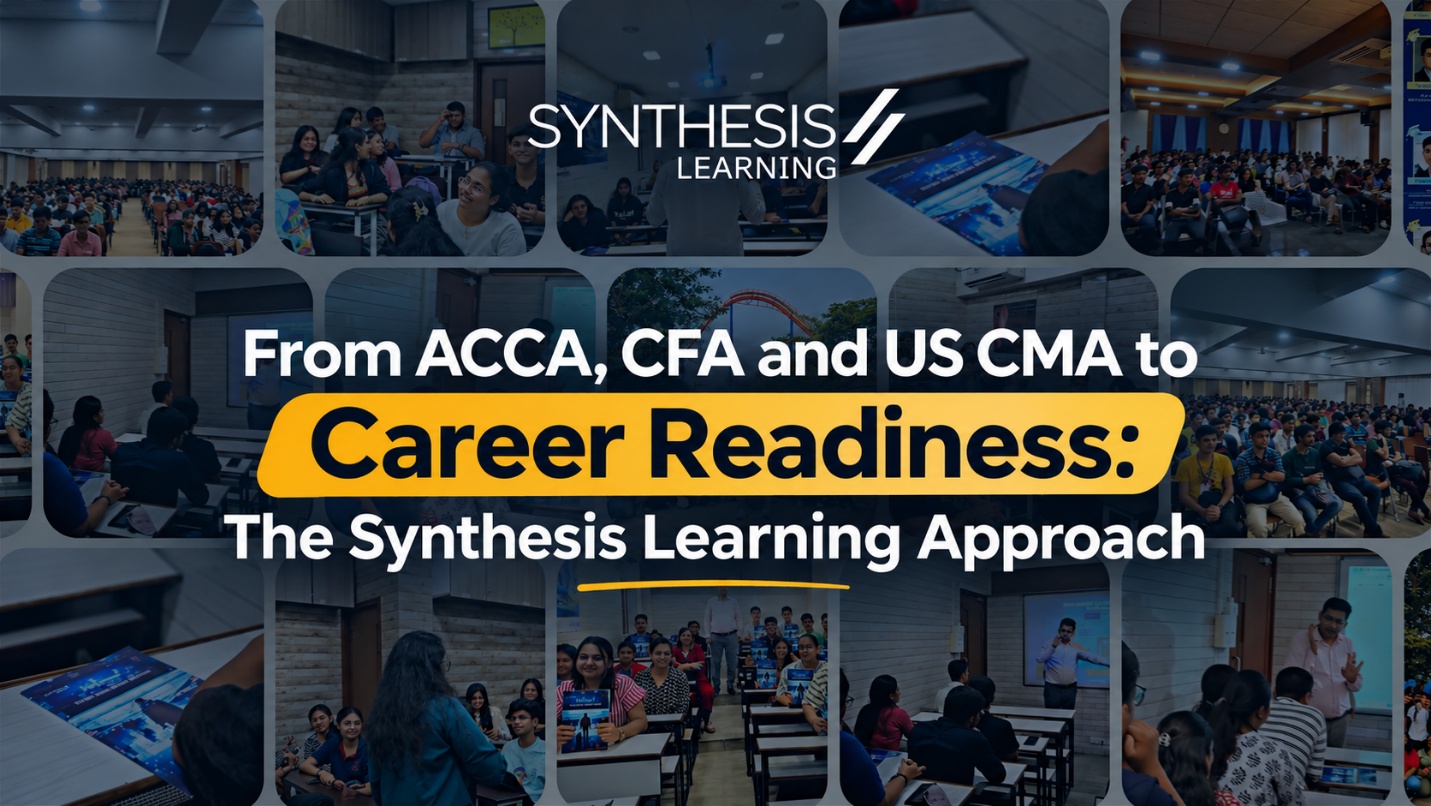
A professional qualification can help students build strong financial knowledge, but preparing for a career requires more than passing examinations. With over 25 years of experience in business and finance education, Synthesis Learning combines globally recognised qualifications such as ACCA, CFA, US CMA & many more with academic mentoring, practical skills and industry exposure to help students prepare for the workplace.
Consider two students applying for the same finance role. Both have studied financial reporting and performed well in their examinations. During the interview, however, one can explain accounting concepts but struggles when asked how those concepts would apply to a real business.
The other can connect the numbers to business decisions, communicate clearly and explain how technology might make the work more efficient.
Their academic knowledge may be similar, but their ability to apply it makes a difference.
This is the gap Synthesis Learning aims to address by bringing career preparation into the professional education journey.
Why Are Professional Finance Qualifications Important for Career Growth?
Qualifications such as ACCA, CFA and US CMA provide specialised knowledge that helps students prepare for different areas of finance.
ACCA (Association of Chartered Certified Accountants) covers accounting, financial reporting, auditing, taxation and business finance. It is relevant for students interested in careers across accounting, audit, financial reporting and corporate finance.
CFA (Chartered Financial Analyst) focuses on investment analysis, financial markets, asset valuation and portfolio management. Students interested in investment research, asset management and related financial services roles may find this qualification particularly relevant.
US CMA (Certified Management Accountant) focuses on management accounting, financial planning, budgeting, cost management and business performance. It is suited to students interested in financial planning and analysis (FP&A), management accounting and corporate decision-making.
Although these qualifications lead towards different career paths, they share an important purpose: developing the financial knowledge needed to understand complex business problems.
Synthesis Learning offers training across these qualifications, helping students choose a path that aligns with their interests, academic background and career goals.
Why Is Passing Finance Exams Not Always Enough to Become Job-Ready?
Imagine a newly qualified finance professional joining a company’s finance team.
Their manager asks them to analyse why operating expenses increased during the last quarter. The financial data is available, but the employee must identify the reasons, prepare a clear explanation and suggest what the business should examine next.
Knowing the relevant accounting concepts is important. So is the ability to work with data, communicate findings and understand the business context.
These practical expectations are not always fully addressed through examination preparation alone.
Technology has also changed the way finance departments operate. Excel, Power BI, financial modelling and AI tools are increasingly relevant to how professionals organise information, analyse performance and communicate results.
For students, developing these abilities alongside their qualifications can make the transition from education to employment more manageable.
How Does Synthesis Learning Help Students Manage Their Professional Studies?
Preparing for a global finance qualification requires consistency, particularly for students balancing their studies with college or employment.
A student pursuing ACCA alongside graduation may have semester examinations, assignments and professional papers to manage. A working professional preparing for US CMA may need to study after office hours or during weekends.
Both need a realistic preparation plan, but their circumstances are different.
Synthesis Learning addresses this through its academic mentoring approach.
Its periodic Mentoring Sessions give students opportunities to review their preparation, discuss academic priorities and identify areas requiring greater attention.
The aim is to help students manage their studies more effectively and develop the discipline needed for professional examinations.
This academic foundation is an important part of the institute’s broader approach to career preparation.
What Is Synthesis Skillstack, and How Does It Prepare Students for Finance Careers?
Synthesis Skillstack is Synthesis Learning’s career-readiness initiative that helps students develop practical, technological, and interpersonal skills alongside their professional qualifications.
The initiative focuses on four areas that students are likely to encounter as they move from education into employment.
Career DNA helps students prepare for the recruitment process. It covers CV building, LinkedIn profile development, job applications and interview preparation.
Tech Stack introduces tools such as Excel, Power BI, financial modelling and AI applications. These skills help students understand how financial information can be organised, analysed and presented in a professional setting.
Own the Room focuses on communication, confidence and professional presence. Students work on presenting ideas, speaking clearly and communicating with people from different backgrounds.
Industry Insider connects students with practising professionals who share insights into career paths, workplace expectations and how finance roles function in different organisations.
The four areas are intended to complement professional education rather than replace the technical knowledge gained through qualifications.
How Does Industry Exposure Help Students Understand Finance Careers?
There is a difference between learning how a financial statement is prepared and understanding how a company uses that statement to make decisions.
Industry interactions can help students connect these two perspectives.
Synthesis Learning’s collaboration with Ascentium India, an ACCA Approved Employer, provides an industry connection to its educational approach.
Learning from practicing professionals can introduce students to workplace expectations, commercial awareness and the responsibilities involved in different finance roles.
For example, a student studying audit may understand the technical requirements of an audit procedure. Hearing how professionals manage client communication, deadlines and business risks can add practical context to that knowledge.
Such exposure is particularly useful for students who have not yet worked in a corporate environment.
What Skills Will Finance Professionals Need as AI Changes the Industry?
AI and automation are changing how businesses process information, prepare reports and analyse financial data.
However, faster access to information does not remove the need for financial understanding.
A business may use technology to identify an unexpected increase in costs. Someone must still examine the reasons, assess the implications and communicate possible solutions.
Speaking at the ET Education Chancellors Conclave 2026 on 23 October 2026, Harsh Surana, Co-Founder & Executive Director of Synthesis Learning, emphasized the importance of combining subject knowledge, effective AI use and human skills.
“There is no substitute for domain knowledge,” he said.
His observation reflects an important consideration for students entering finance. Technology can support their work, but understanding financial concepts, thinking critically and communicating effectively remain essential.
This is also the thinking behind combining professional qualifications with practical skill development.
How Can Students Prepare for a Career Beyond ACCA, CFA or US CMA?
Building a career in finance involves several stages. Students must first develop technical knowledge, prepare for professional examinations and understand the career paths available to them.
They must also learn how to apply that knowledge in a workplace where technology, communication and business understanding are increasingly important.
Synthesis Learning brings these areas together through global finance qualifications, academic mentoring, Synthesis Skillstack and industry exposure.
Its approach recognizes that professional examinations are an important milestone, but they are not the final step in preparing for a finance career.
For students pursuing ACCA, CFA or US CMA, the goal is not simply to complete a qualification. It is to develop the knowledge, skills and confidence to use that qualification effectively throughout their careers.